
A medical equipment appraisal is an independent opinion of value for healthcare equipment, prepared by an ASA-accredited equipment appraiser. Practice owners and administrators, hospitals, physician, dental, optometry, and ophthalmology practices, surgery centers, imaging centers, and laboratories rely on these reports, as do the lenders, attorneys, executors, and CPAs who support them. Common reasons include selling or acquiring a practice, property taxes and other tax matters, estate settlement, litigation, lending, insurance claims, and financial reporting. Reports from Sencer Appraisal Associates are prepared to meet the professional standards and the requirements of the intended user, lenders, courts, or taxing agencies.
Sencer Appraisal has valued equipment since 1955. The firm’s medical and healthcare practice is led by Matthew Edelstein, ASA, who holds the Advanced Education in Healthcare Valuation Program credential from the American Society of Appraisers (ASA), with co-principal Garrett Schwartz, FASA, CEA, a past International President of the ASA. Every medical and healthcare equipment valuation report is signed by an Accredited Senior Appraiser of the ASA and is compliant with the Uniform Standards of Professional Appraisal Practice (USPAP). For clients reporting under other frameworks, our valuers work to the applicable standard, including U.S. GAAP, International Financial Reporting Standards (IFRS), and International Valuation Standards (IVS).
Need a medical equipment value you can stand behind? Call Sencer Appraisal at 888-473-6237 or use the Request a Proposal form. We’ll walk you through the process and discuss the assets, intended use, timing, and reporting requirements before recommending the appropriate scope of work and providing a proposal with fees and turnaround times.
What medical equipment we appraise
Medical equipment valuations may involve a single device, a department, a practice, an imaging center, a laboratory, or an entire hospital or health system. Sencer Appraisal values healthcare assets across clinical, diagnostic, surgical, dental, optometry, laboratory, and home-care settings, including:
The photos below are from medical equipment appraisals completed by our own ASA-accredited appraisers.
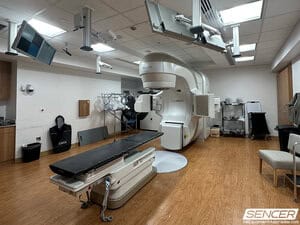
A Varian TrueBeam linear accelerator, valued during a hospital equipment appraisal.
Hospital and health-system equipment.
A hospital equipment appraisal covers diagnostic and treatment equipment across departments, including patient monitoring systems, radiation oncology and treatment equipment, ventilators and respiratory equipment, infusion pumps and dispensing cabinets, sterilization and central processing equipment, laboratory analyzers, and the buildouts that tie a facility together. We value a single department, an entire hospital, or mobile clinic fleets. Hospital equipment valuation work ranges from a single imaging suite to a full asset register at the system level.
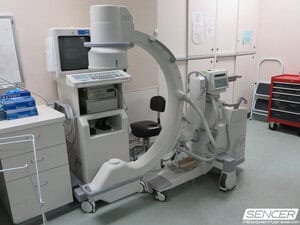
A GE OEC mobile C-arm, valued during a diagnostic imaging equipment appraisal.
Diagnostic imaging equipment.
MRI systems, CT scanners, PET and nuclear medicine systems, X-ray and radiography equipment, mammography systems, C-arms, and ultrasound machines and transducers, across fixed, mobile, and imaging-center installations.
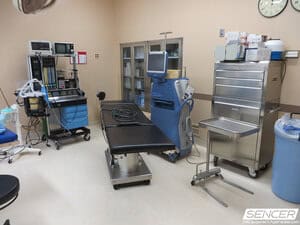
Operating-room equipment, valued during a surgical equipment appraisal.
Surgical and operating-room equipment.
Operating tables and surgical lights, anesthesia machines, electrosurgical units, endoscopy and laparoscopy systems, surgical lasers, and sterilization equipment for hospital operating suites and ambulatory surgery centers.
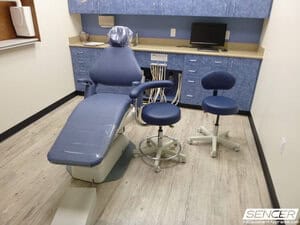
A dental operatory, valued during a dental equipment appraisal.
Dental equipment.
We value dental chairs and delivery units, intraoral and panoramic imaging, cone-beam CT, CAD/CAM and milling systems, sterilizers, handpieces, and dental lasers, for practice buy-ins, sales, lending, and estate matters. We appraise the equipment itself, distinct from the value of the dental practice as a whole. See our dental equipment appraisals page for more information.
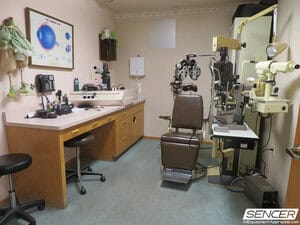
An optometry exam lane, valued during an optometry equipment appraisal.
Optometry and ophthalmology equipment.
Phoropters, slit lamps, autorefractors and lensometers, optical coherence tomography (OCT) systems, fundus and retinal cameras, visual field analyzers, and ophthalmic surgical lasers.
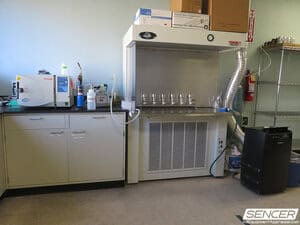
Laboratory biosafety equipment, valued during a laboratory equipment appraisal.
Clinical and laboratory equipment.
We value clinical and diagnostic laboratory equipment, including chemistry, hematology, immunoassay, and molecular analyzers, centrifuges, microscopes, incubators, biosafety cabinets, and ultra-low freezers, for hospital laboratories, pathology groups, and diagnostic and clinical research labs. See our clinical and laboratory equipment appraisals page for additional details.
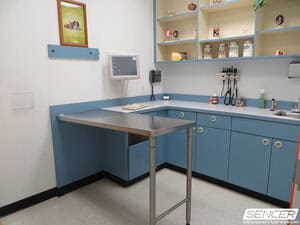
A veterinary exam room, valued during a veterinary equipment appraisal.
Veterinary and animal-care equipment.
We value the equipment in companion-animal and specialty veterinary practices and hospitals, including anesthesia machines and patient monitors, surgical and radiography equipment, ultrasound, in-house laboratory analyzers, dental and sterilization equipment, and kennels and recovery enclosures. We appraise the equipment itself, distinct from the value of the veterinary practice as a whole.
We value equipment from manufacturers including GE Healthcare, Siemens Healthineers, Varian, Elekta, Philips, Canon Medical, Hologic, Stryker, Medtronic, Steris, Draeger, Mindray, Midmark, A-dec, Dentsply Sirona, Planmeca, Beckman Coulter, Roche, Abbott, and Thermo Fisher Scientific, among many others. If your equipment is not listed here, contact us. We are glad to talk through your specific assets.
When healthcare organizations need medical equipment appraisals
Healthcare organizations need medical machinery appraisals when a lender, court, tax authority, auditor, insurer, buyer, seller, partner, trustee, or administrator requires a defensible value opinion. The intended use determines the value definition, scope of work, inspection requirements, and report format. Common reasons include:
- Financing and collateral loans. Lenders, such as your local bank or credit union, need a credible value to set borrowing capacity and approve asset-based lending, including SBA-backed loans.
- Mergers, acquisitions, and practice transitions. Equipment values are a standard part of due diligence when a hospital system, physician group, or practice changes hands.
- Partnership buy-ins and buy-outs. Physicians and practice partners need a value to price ownership interests when a partner joins or leaves the practice.
- Insurance. Replacement cost and actual cash value appraisals support the right coverage limits and provide an objective baseline for settling disputes or loss claims after a fire, flood, or theft.
- Estate and gift taxes. In the U.S., the Internal Revenue Service may require a qualified appraisal of business assets when a practice owner’s estate is settled or interests are transferred.
- Divorce and litigation. A third-party opinion of value gives courts, legal counsel, and the parties a documented figure, supported by expert witness testimony when required.
- Shareholder disputes and buyouts. Many jurisdictions require a fair value determination when shareholders are bought out. In California, Corporations Code Section 2000 governs certain buyouts in close corporations. In Delaware, Section 262 of the General Corporation Law gives dissenting shareholders appraisal rights. Courts in both states and across the U.S. rely on independent valuations of the underlying assets.
- Eminent domain and condemnation. An accredited appraisal establishes the value of machinery and equipment before a government taking, supporting just-compensation claims under federal and state condemnation procedures.
- Bankruptcy and restructuring. Trustees, debtors, secured creditors, and counsel rely on accredited appraisals for plan confirmation, secured-claim treatment, going-concern and liquidation analysis, and valuation for asset sales.
- Property tax and ad valorem appeals. An accredited appraisal supports an appeal by establishing the defensible market value of equipment for the tax year, often where the assessor relied on cost-trended data rather than market evidence.
- Financial reporting and purchase price allocations. After a business acquisition, equipment is valued to allocate the purchase price across assets and to test for impairment. Applicable frameworks may include Accounting Standards Codification 805, Business Combinations (ASC 805); Accounting Standards Codification 820, Fair Value Measurements (ASC 820); and Accounting Standards Codification 360, Property, Plant, and Equipment (ASC 360) under U.S. Generally Accepted Accounting Principles (U.S. GAAP); International Financial Reporting Standard 3, Business Combinations (IFRS 3), and International Accounting Standard 36, Impairment of Assets (IAS 36) under IFRS; and Internal Revenue Code Section 1060 (IRC §1060) for U.S. federal tax filings.
- Charitable contributions. An accredited appraisal documents the value of equipment given to a charitable organization for the donor’s records.
Why an accredited appraisal beats a dealer quote or online estimate
A dealer trade-in figure or online asking price may give you a rough indication of market activity, but it is not an accredited opinion of value and usually will not satisfy lender, tax, litigation, insurance, or financial-reporting requirements.
Medical equipment also presents a particular challenge. Resale markets are specialized, configuration and software licensing affect value, and a recently installed imaging system can carry a very different value from its original cost. An accredited appraisal closes that gap through careful research, inspection, or detailed asset review, and the appraiser’s judgment about condition, age, remaining useful life, and the market for that specific asset. The result is a value that reflects the actual equipment in front of you, not a generic make-and-model average.
How we determine medical equipment value
The valuation method depends on the asset type, available records, intended use, and required level of inspection or documentation. Most medical equipment appraisals use one of two scope models:
- Uninspected desktop appraisal: Medical equipment may be well documented through asset registers, model and serial numbers, and service records, so some medical valuations can be completed remotely as uninspected desktop appraisals. The client provides an asset list and supporting records, and our appraisers complete the valuation from our offices. This option can reduce costs, and it suits financial reporting, preliminary planning, and many transactions.
- Field appraisal: An appraiser or expert associate visits the facility to inspect the equipment in person. On-site inspection provides additional verification of asset existence, configuration, condition, and context, and it is more appropriate for litigation, complex or high-value assets, and large multi-department facilities.
We report the definition of value called for by the assignment. That might be fair market value, fair market value in-use, orderly liquidation value, forced liquidation value, fair value, or another definition called for by the purpose of the equipment valuation. Whether you need a few devices valued or an entire health system, we explain which definition fits and why, and deliver a clear, well-documented report.
Why work with Sencer Appraisal
- ASA accreditation on every report. Each appraisal is signed by an Accredited Senior Appraiser of the American Society of Appraisers (ASA). The firm is led by Matthew Edelstein, ASA, a long-time ASA chapter officer with ASA’s Healthcare Valuation Program credential, and Garrett Schwartz, FASA, CEA, a past International President of ASA. Both have years of experience valuing medical equipment.
- Seventy years of appraisal practice. Founded in 1955, Sencer Appraisal has corporate offices in Chadds Ford, Pennsylvania and Oakland, California, supported by a national network of expert associates.
- Reports built for the intended purpose. We prepare reports for hospitals, physicians, lenders, tax authorities, courts, insurers, auditors, trustees, and business owners, with USPAP compliance for U.S. engagements and IVS alignment or other applicable standards. Our valuations are scoped to the assignment, including IRS and U.S. GAAP guidelines, International Financial Reporting Standards, International Valuation Standards, and U.S. Small Business Administration requirements when applicable.
- Independence. We don’t auction, sell, or broker equipment, and we hold no financial interest in the equipment we appraise, so our opinion of value is fair and unbiased.
FAQ
Frequently Asked Questions
Common questions about medical, dental, and laboratory equipment appraisals.
What is a medical equipment appraisal?
What types of medical equipment do you appraise?
How is the fair market value of medical equipment determined?
How much does a medical equipment appraisal cost?
Can a medical equipment appraisal be done remotely?
Do you appraise dental, optometry, and clinical laboratory equipment?
Who is qualified to appraise medical equipment?
How long does a medical equipment appraisal take?
Will the appraisal hold up for the IRS, a lender, a tax authority, or a court?
How do I value medical equipment for IRS Form 706?
Where does Sencer Appraisal value medical equipment?
Projects are managed from our offices in Chadds Ford, Pennsylvania, and Oakland, California, supported by our network of expert associates.
We serve industry and offices across the Northeast, including Delaware, Maryland, New Jersey, New York, Pennsylvania, and Virginia, along with Connecticut, Maine, Massachusetts, New Hampshire, Rhode Island, Vermont, West Virginia, and the District of Columbia.
We appraise equipment throughout the Southeast, including Florida, Georgia, North Carolina, South Carolina, Tennessee, Alabama, Mississippi, Kentucky, Louisiana, and Arkansas.
Our Southwestern work covers Texas, Arizona, New Mexico, Oklahoma, and Colorado, with appraisals performed on-site or on an uninspected desktop basis.
Prepared by Matthew Edelstein, ASA (Chadds Ford office) and Garrett Schwartz, FASA, CEA (Oakland office), principals of Sencer Appraisal Associates.