
A farm equipment appraisal is an unbiased, independent opinion of value for the machinery used in farming, ranching, and agribusiness, signed by an ASA-accredited equipment appraiser. Farm and agribusiness owners, lenders, attorneys, CPAs, and estate administrators rely on these reports for loans, tax filings, litigation, insurance, and business sales. Reports from Sencer Appraisal Associates meet professional standards and the requirements of the intended user, so they hold up with lenders, courts, tax authorities, and the IRS.
Sencer Appraisal has valued equipment since 1955. Every agricultural and farm equipment valuation report is signed by an ag equipment appraiser accredited as an Accredited Senior Appraiser of the American Society of Appraisers (ASA). For clients operating under U.S. standards, each appraisal is compliant with the Uniform Standards of Professional Appraisal Practice (USPAP). For clients reporting under other frameworks, our valuers work to the standard that applies to them, such as the International Valuation Standards (IVS).
Need a value you can stand behind? Call Sencer Appraisal at 888-473-6237 or use the Request a Proposal form. We’ll walk you through the process.
Looking for a certified farm equipment appraiser?
What farm equipment we appraise
Every farming sector runs on its own machinery, and a tractor built for a vineyard is a different asset from one built for a high-acreage row-crop operation. Our appraisers and expert associates value the full range of agricultural assets, from a small group of tractors to an entire operation, including:
The photos below are from farm and agricultural equipment appraisals completed by our own ASA-accredited appraisers.
Tractors and harvesting equipment
Utility tractors, row-crop tractors, high-horsepower and articulated tractors, compact tractors, narrow orchard and vineyard tractors, combines, corn heads, grain platforms and draper headers, forage harvesters, cotton pickers and strippers, nut and berry mechanical harvesters and sweepers, sugar beet and potato harvesters, windrowers and swathers, specialty crop harvesters, and specialty power units.
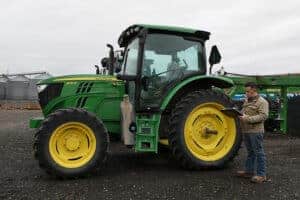
Garrett Schwartz, FASA, CEA, inspecting a John Deere 6120R row-crop tractor for a Northern California equipment appraisal assignment.
Planting, seeding, and tillage equipment
Plows, disc harrows, field cultivators, rippers and subsoilers, vertical tillage and strip-till units, planters, grain drills, air seeders, air carts, and precision planting systems.

VM seeder valued during a farm equipment appraisal.
Sprayers and application equipment
Self-propelled and pull-type sprayers, dry and liquid fertilizer spreaders, anhydrous ammonia applicators, and nutrient management systems.

A Progressive Ag / LectroBlast 1530 orchard sprayer, valued during a vineyard equipment appraisal.
Hay and forage equipment
Round and square balers, mower conditioners, disc and drum mowers, rakes and tedders, forage wagons, and bale wrappers and processors.

A Massey Ferguson Hesston 2270XD baler valued during a contract harvester equipment appraisal.
Grain handling and storage
Grain bins, augers and conveyors, grain legs and elevators, grain dryers, aeration systems, and grain carts.
Irrigation
Center pivot and lateral-move systems, drip and micro-irrigation, pumps and power units, hose reels, and water-control and filtration infrastructure.
Material handling and utility equipment
Skid steers and compact track loaders, telehandlers, front loaders and attachments, utility vehicles and ATVs, and farm trucks and trailers.
Specialty crop and vineyard equipment
Vineyard machinery appraisal covering narrow vineyard tractors, mechanical grape harvesters, vineyard cultivation equipment, and frost-protection wind machines; fruit tree, nut and berry harvesting equipment, including harvesters, sweepers, conditioners, carts, shakers, and orchard sprayers; coffee harvesting and processing equipment, including mechanical harvesters, pulpers, dryers, and roasters; packing lines; cold storage and refrigeration; and nursery and greenhouse systems.
Our brewery, winery, and distillery equipment appraisal page covers winery crush-pad, cellar, and bottling equipment, along with brewery and distillery equipment.

An Oxbo 7440 berry-harvester valued during a blueberry producer’s equipment appraisal

A Wiesner Metal Fab hazelnut harvester and nut cart valued during a hazelnut grower’s equipment valuation
Manufacturers we value
We value equipment from manufacturers including John Deere, Case IH, New Holland, Kubota, Massey Ferguson, AGCO, Fendt, Claas, Caterpillar, Bobcat, Vermeer, Krone, Kuhn, GEA, and Pellenc, among many others. If your equipment is not listed here, contact us. We are glad to talk through your specific machinery.
When farm operations need an equipment appraisal
Agricultural machinery appraisals and farm equipment valuations are requested for a broad range of financial, legal, and management reasons. The applicable reason depends on your situation, jurisdiction, and reporting context. The most common include:
- Financing and collateral loans. Lenders, such as your local bank, credit union, or Farm Credit office, need a credible value to set borrowing capacity and approve asset-based lending, including SBA-backed loans.
- Insurance. Replacement cost and actual cash value appraisals support the right coverage limits and provide an objective baseline to settle insurance disputes or total loss claims after a fire, flood, or theft.
- Buy-sell agreements. Partners and shareholders use a fair value to price ownership interests when the company changes hands or ownership shares change.
- Business sales, mergers, and acquisitions. Equipment values are a standard part of due diligence for buyers, sellers, lenders, brokers, and advisors.
- Estate and gift taxes, and family-farm succession. In the U.S., the Internal Revenue Service may require a qualified appraisal of business assets, and a clear value helps families hand an operation to their heirs.
- Divorce and litigation. A third-party opinion of value gives courts, legal counsel, and the parties a documented figure, supported by expert witness testimony when required.
- Shareholder disputes and buyouts. Many jurisdictions require a fair value determination when shareholders are bought out. In California, Corporations Code Section 2000 governs certain buyouts in close corporations. In Delaware, Section 262 of the General Corporation Law gives dissenting shareholders appraisal rights. Courts in both states and across the U.S. rely on independent valuations of the underlying assets.
- Eminent domain and condemnation. An accredited appraisal establishes the value of machinery and equipment before a government taking, supporting just-compensation claims under federal and state condemnation procedures.
- Bankruptcy and restructuring. Trustees, debtors, secured creditors, and counsel rely on accredited appraisals for plan confirmation, secured-claim treatment, going-concern and liquidation analysis, and valuation for asset sales.
- Property tax and ad valorem appeals. An accredited appraisal supports an appeal by establishing the defensible market value of equipment for the tax year, often where the assessor relied on cost-trended data rather than market evidence.
- Financial reporting and purchase price allocations. After a business acquisition, equipment is valued to allocate the purchase price across assets and to test for impairment. Applicable frameworks may include Accounting Standards Codification 805, Business Combinations (ASC 805); Accounting Standards Codification 820, Fair Value Measurements (ASC 820); and Accounting Standards Codification 360, Property, Plant, and Equipment (ASC 360) under U.S. Generally Accepted Accounting Principles (U.S. GAAP); International Financial Reporting Standard 3, Business Combinations (IFRS 3), and International Accounting Standard 36, Impairment of Assets (IAS 36) under IFRS; and Internal Revenue Code Section 1060 (IRC §1060) for U.S. federal tax filings.
Why an accredited appraisal beats a blue-book number
Free online value guides may give you an average price built from dealer and auction listings. That can be a useful starting point, but it is not an accredited opinion of value and won’t be acceptable for a lender, tax filings, litigation, insurance claims, or financial reporting.
Farm machinery appraisal comes with a particular challenge. Much of this equipment sells in private-party transactions, so public sales data is thin. An accredited appraisal closes that gap through hands-on inspection, careful research, and the appraiser’s judgment about condition, hours, configuration, and the operating environment the machine works in. The result is a value that reflects the actual asset in front of you, not a generic make-and-model average.
How we determine value
We match the engagement to your assets and your needs:
- Field appraisal: An appraiser or expert associate visits your farm, ranch, or facility to conduct a personal inspection of the equipment. This creates the highest level of valuation defensibility for litigation, tax disputes, and asset-based lending.
- Uninspected desktop appraisal: When an on-site visit is not practical or is not required for the intended purpose, a desktop equipment appraisal is an alternative. The client or equipment owner provides equipment records and photos, and our appraisers complete the valuation from our offices.
We report the definition of value called for by the assignment. That might be fair market value, orderly liquidation value, forced liquidation value, fair value, or another definition appropriate to the purpose of the equipment valuation. Whether your ag machinery appraisal covers a few machines or an entire farm operation, we explain which definition fits and why, then deliver a clear, well-documented report.
Why work with Sencer Appraisal
- ASA-accreditation on every report. Each appraisal is signed by an Accredited Senior Appraiser of the American Society of Appraisers, and the firm is led by a past International President of the ASA and a long-time ASA chapter officer.
- Over seventy years of appraisal practice. Founded in 1955, with corporate offices in Chadds Ford, Pennsylvania, and Oakland, California, supported by a network of expert associates.
- Reports built for the intended purpose. We prepare reports for lenders, tax boards, courts, insurers, auditors, trustees, and business owners, with USPAP compliance for U.S. engagements and IVS alignment or other standards that apply. Our valuations meet the standard called for by the assignment, including IRS regulations, U.S. GAAP guidelines, International Valuation Standards, and U.S. Small Business Administration procedures.
- Independence. We don’t auction, sell, or broker equipment, and we hold no financial interest in the machinery we appraise, so our opinion of value is fair and unbiased.
FAQ
Frequently Asked Questions
Common questions about agricultural and farm machinery and equipment appraisals.
What is a farm equipment appraisal?
What is a chattel appraisal?
What types of farm equipment do you appraise?
How much does a farm equipment appraisal cost?
Who is qualified to appraise farm machinery?
Who should appraise farm equipment in a divorce?
How long does a farm equipment appraisal take?
Do I need an on-site inspection, or will a desktop appraisal work?
Is there a Kelley Blue Book for farm equipment?
How is a USPAP-compliant report different from a blue-book value?
Will the appraisal hold up for the IRS, a lender, or a court?
Where does Sencer Appraisal value farm equipment?
Projects are managed from our offices in Chadds Ford, Pennsylvania, and Oakland, California, supported by our network of expert associates.
We serve industry and offices across the Northeast, including Delaware, Maryland, New Jersey, New York, Pennsylvania, and Virginia, along with Connecticut, Maine, Massachusetts, New Hampshire, Rhode Island, Vermont, West Virginia, and the District of Columbia.
We appraise equipment throughout the Southeast, including Florida, Georgia, North Carolina, South Carolina, Tennessee, Alabama, Mississippi, Kentucky, Louisiana, and Arkansas.
Our Southwestern work covers Texas, Arizona, New Mexico, Oklahoma, and Colorado, with appraisals performed on-site or on an uninspected desktop basis.
Prepared by Garrett Schwartz, FASA, CEA (Oakland office) and Matthew Edelstein, ASA (Chadds Ford office), principals of Sencer Appraisal Associates.